Democracy, Social Media and Local Political Debates in Europe, Brussels, Belgium, 17 September 2026

73% of respondents believe social media shape political debates in their communities, but only 24% say they influence their own opinion. This sharp contrast between perceived social influence and personal influence frames RegioDev’s event on democracy, social media and participation, organised in Brussels within the ProVote project.
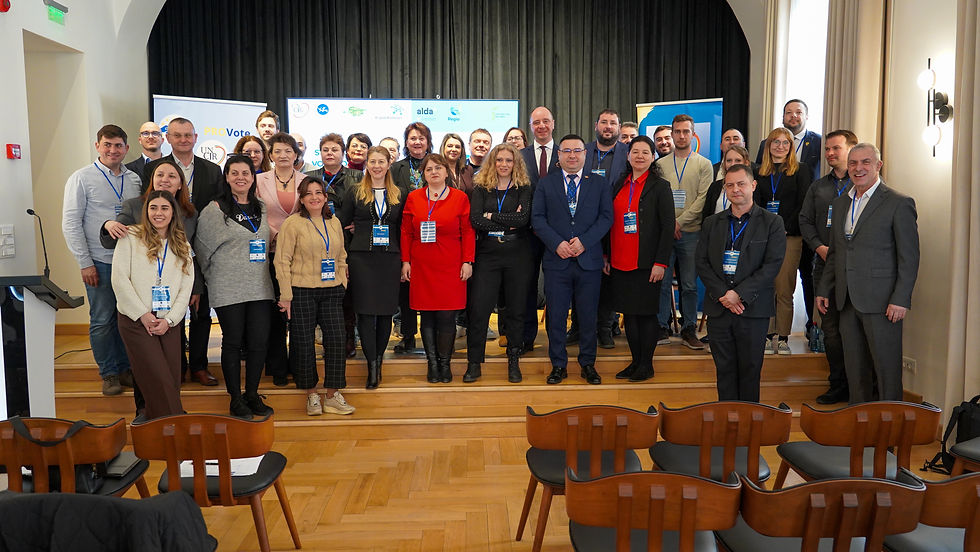
photos by Philipp Schröder
The discussion brought together EU, local-government, civil-society and digital-security perspectives. A common message emerged from speakers and the audience: credibility creates trust, therefore credibility matters. Citizens need trustworthy information, reliable institutions and digital spaces that do not reward manipulation, harassment or polarisation.
Sovereignty and trusted platforms
Opening the first panel, Nicolas Reynès, Coordinator of Partenalia aisbl, presented the results of a questionnaire completed by project partners in seven EU countries on the impact of social media on local political debate. Despite different national and local contexts, the findings pointed to a similar pattern: social media are seen as essential channels for accessing information and engaging with public affairs, yet they also intensify concerns about polarisation, misleading content, hostile exchanges and declining confidence in political communication. The results highlighted a common need for more credible local information, stronger media literacy and safer spaces for democratic dialogue.
Mats Pellback-Scharp, Board Member and Co-Founder of W Social, argued that European digital sovereignty will remain an ambition unless citizens are prepared to use and support European alternatives. He presented W as an attempt to build a different kind of social network: one where verified users, European data governance and open technical standards can help limit bots, impersonation and coordinated manipulation. He also pointed to W’s live stream of the State of the European Union address the previous day, where the discussion was noticeably more civil and constructive than exchanges around the same event on larger platforms such as YouTube and X. The example reinforced a wider point in the panel: platform design can shape the tone of political debate, but credible European alternatives need active users if they are to become viable public spaces.
Aleks Vangelofski, Senior Manager for Strategy for Trusted European Platforms at Europe MédiaLab, argued that Europe needs to move beyond diagnosing the problem and give European digital initiatives the political backing and long-term funding required to grow. He presented the Trusted European Platforms (TEPs) initiative, through which Europe MédiaLab seeks to bring together and support European platforms that can offer more reliable spaces for public debate. The ambition is to help these initiatives gain visibility, build partnerships and reach the scale needed to compete in a market dominated by global platforms.
Vangelofski also stressed that a safer internet should not be framed solely as a matter of child protection. Adults, too, need more trustworthy online environments and the skills to assess sources, recognise manipulation and participate responsibly in public debate. In this sense, media literacy and investment in credible European platforms are complementary: neither can replace the other, but both are needed to strengthen democratic resilience.
The discussion around W Social and other European social media platforms also highlighted the test facing all emerging European alternatives: credibility needs to be earned. A platform must offer real safeguards against manipulation while remaining accessible, protecting users’ rights and attracting a sufficiently broad community to sustain meaningful public debate.
Local democracy and resilience
In the second panel, Daniel Fleischer-Ambrus, Team Leader for Democracy at the European Commission’s DG Justice, placed the discussion within Europe’s wider democratic-resilience agenda. He addressed the need to safeguard participation, strengthen trust in public institutions and protect citizens from the pressures that can distort democratic life, including disinformation, polarisation and online intimidation. The exchange considered how European action, including the European Democracy Shield, can be translated into practical support for democratic debate at local level.
Denys Tkachov, Digitalisation Hub Coordinator at ALDA, focused on the experience of local authorities and civic organisations. Digital tools and social media can give citizens easier access to information, create channels for engagement and make local decision-making more visible. Their value, however, depends on how they are used. Local authorities need the capacity to communicate clearly, moderate difficult conversations, reach people excluded from digital participation and demonstrate that public engagement can lead to real decisions and change.
Valeria Dima, cybersecurity expert at Europuls, highlighted that democratic resilience also depends on digital security. Local authorities, elected representatives, candidates and civil-society organisations can face compromised accounts, data breaches, manipulated content and coordinated harassment. Practical cyber hygiene, secure communication and greater awareness are therefore essential conditions for credible local political debate—not only technical measures.
A shared challenge
The event underlined that European democracy cannot be safeguarded through regulation alone. Stronger rules must be matched by media literacy, cybersecurity, transparent communication and investment in trustworthy digital spaces.
The key challenge is local as much as European. Online polarisation quickly affects public trust, local institutions and community relations. Rebuilding democratic participation requires platforms and public authorities that enable citizens to access reliable information, take part safely and see that their contribution can shape decisions.
Following the panel discussions ProVote partners continued the day with guided visits to the Parliamentarium of the European Parliament and the House of European History. The visits offered a wider perspective on the development of European integration, the workings of the European Parliament and the often difficult history that has shaped the Union. They also created space for partners to reflect together on the future of European democracy: how participation can be renewed, how democratic institutions can remain credible and how European values can be defended in an increasingly contested digital public sphere.


Comments